
Marriage Meeting Questions to Help You Focus on What Matters
You can spend an entire week beside your spouse and still miss something important about how they’re feeling.
You’ve shared meals, exchanged messages, and fallen asleep in the same bed. You’ve talked about work, dinner, and the weekend. But perhaps there’s a worry they haven’t found the words for. Or something you did that made them feel loved and they haven’t had a chance to tell you.
Sometimes you’re the one hoping they’ll ask.
A Marriage Meeting makes room for those parts of your life together. There’s time to finish a thought, explain why something mattered, and hear an answer you might have missed during a busy week.
The right marriage meeting questions can help you find your way into that conversation. They give you somewhere to begin when you want to connect but aren’t quite sure what to say.
You may find something worth celebrating, a difficulty you both recognize, or a priority that feels especially important this week. You don’t have to discuss every part of your marriage. You’re making time to understand what matters to the person sharing it with you.
Three Marriage Meeting Questions to Start With
A weekly Marriage Meeting is time you set aside to talk about your relationship, appreciate each other, and consider what you need in the days ahead.
If you’re trying it for the first time, begin with these three questions:
What felt good between us this week?
What would you like me to understand about something that felt difficult?
What matters most for us to give attention to in the coming week?
Let each person answer. You might discover that you’ve noticed the same things or that your spouse experienced the week differently.
You don’t need to move quickly through the questions. A thoughtful follow-up can be more useful than reaching the end of a list.
Below are questions to help you explore each area more fully, followed by a way to make choosing your weekly focus easier.
What’s Working Well—and Where Do You Agree?
It feels good to know your spouse notices the effort you’re making.
Maybe you handled a stressful week together. Maybe you made more time for affection, shared a responsibility more fairly, or found yourselves laughing over something small.
These moments deserve a place in your meeting. Talking about what felt good helps you understand what your spouse appreciates and what you both want to keep making room for.
Ask:
What’s something I did this week that made you feel loved or supported?
What do you think we handled well together?
What would you like us to keep doing because it’s making a difference?
Be specific when you can. “Thanks for helping this week” becomes more personal when you explain what you noticed:
“When you took care of dinner after my long day, I felt like you understood how tired I was.”
Give your spouse a moment to receive that appreciation. You don’t have to follow it immediately with something that needs improving.
You may also discover agreement about a concern. Perhaps you both miss having time together, or both feel that your weekends have become too crowded. Recognizing a shared experience can help you decide what to explore next.
What Needs More Attention?
Some feelings are easy to set aside during a busy week. You tell yourself it wasn’t a big deal, that your spouse was tired, or that you’ll bring it up when there’s more time.
A Marriage Meeting gives those experiences a place to be heard.
You might want to talk about feeling disconnected, carrying too much responsibility, or misunderstanding each other during a recent conversation. Choose something specific enough that your spouse can understand the experience behind it.
Ask:
What felt difficult for you this week that I might not have noticed?
What would you like me to understand about how that affected you?
What’s one realistic change we could try together?
Give each other time to answer before choosing a solution.
For example, “I miss spending time with you” could mean wanting an evening out, a few uninterrupted minutes after dinner, or more affection during an ordinary day. Ask what that need looks like to your spouse.
You might say:
“When you say you’ve been missing me, what kind of time together would feel good to you?”
That answer gives you something to work with. Perhaps a short walk together would mean more than an elaborate date neither of you has the energy to organize.
You can share your own needs, too. Look for a next step both of you understand and willingly agree to try.
What Matters Most This Week?
The subject that deserves attention may be an upcoming decision, a change in your lives, or something you’ve been meaning to make room for.
Perhaps a family visit needs a conversation about expectations. One spouse may be heading into a demanding week and need practical support. Or you might want to protect something positive, such as time together that has recently started to feel easier.
Ask:
What feels most important for us to give attention to right now?
What would meaningful support or progress look like to each of us?
What should we agree to do, and when will we revisit it?
Try to understand why the subject matters before deciding how to handle it.
An upcoming expense may be important because of the amount involved. It may also bring up worries about financial security or whether both spouses have a voice in the decision. Give those concerns room alongside the practical details.
You may be ready to make an agreement. You may need more information or another conversation. Either way, leave knowing what happens next.
How Do You Know What to Focus On?
You may already know what you want to discuss. Perhaps you’ve had a wonderful week together and want to keep that feeling going. Maybe a responsibility has become frustrating, or an upcoming decision needs both of your attention.
But sometimes it’s harder to put your finger on what matters. You know something feels different, yet “How are we doing?” seems too broad to produce a useful answer.
This is where reflecting individually before your conversation can help. Each spouse gets time to consider their own experience before responding to the other.
Happy & Married gives that reflection a regular structure. Through a private Weekly Marriage Check-In, each spouse considers ten important areas of the marriage, including communication, finances, intimacy, time together, and support.
You then bring what you choose to share into your Marriage Meeting. We call this the Reflect & Connect Method:
Reflect: Consider your own experience through your private Weekly Check-In.
Connect: Come together to discuss what you’ve noticed and what you want to do next.
For couples who want more guidance on where to begin, Premium’s Data-Driven Marriage experience uses both spouses’ Check-Ins to highlight three relevant starting points:
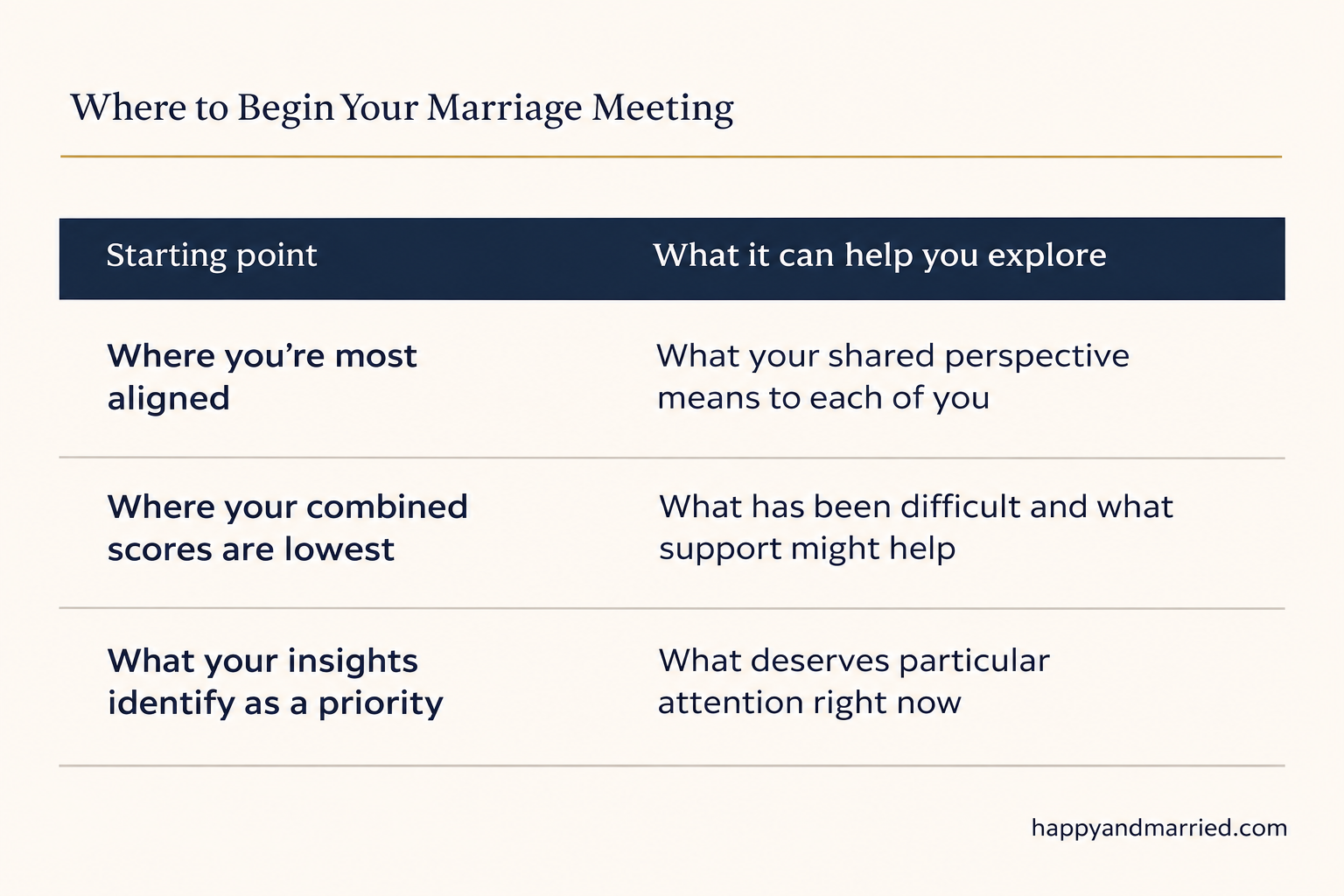
You still decide what to discuss. The information gives you a starting point, and your conversation helps you understand what’s behind it.
Alignment also doesn’t automatically mean everything feels great. You might both agree that an area needs attention. Similarly, a lower combined score doesn’t mean you had identical experiences.
Premium’s shared scores, trends, and insights offer things to explore together while individual responses stay private. They don’t decide whose experience is correct or explain every reason behind a change.
Explore Happy & Married Premium.
You Don’t Have to Discuss Everything Every Week
Looking at the whole marriage during private reflection and discussing every area together are different tasks.
Your meeting can focus on the core subjects that matter most this week. Some weeks, you’ll have several short conversations. Other weeks, one subject will deserve most of your time.
Let each other know what you want to discuss and choose where to begin together. If time permits, explore other areas. If something needs a longer conversation, arrange a time to return to it.
You can have a meaningful meeting without covering every Marriage Pillar.
Also, give important matters attention when they arise. A regular meeting creates a dependable opportunity to connect; it shouldn’t delay a conversation that needs to happen sooner.
Let Your Spouse’s Answer Guide the Conversation
A useful question opens a door. What happens next depends on how you listen.
If your spouse shares something you didn’t expect, resist the urge to immediately explain why you saw it differently. Ask for a little more context:
“Can you tell me about a moment that captures how that felt for you?”
A specific example can make an experience easier to understand. Your spouse might describe feeling interrupted during a conversation you barely remember, or feeling supported by a gesture you hadn’t realized mattered.
Before responding, check what you heard:
“You felt like I was already moving on before you’d finished telling me. Have I understood?”
You can explain your perspective, too. Both people need room to speak, ask questions, and consider what they’ve heard.
If the conversation becomes too heated to listen well, pause and agree on when you’ll return. You don’t have to force an answer or finish a difficult subject simply because you set aside time for a meeting.
Close With One Agreement and Something to Appreciate
Before you finish, ask:
What’s one thing we want to carry into the coming week?
How can we each help make that happen?
What did you appreciate about our conversation today?
Your agreement might be practical, such as sharing a responsibility or setting aside time for a decision. It might also be something enjoyable you want to repeat.
Make it clear enough that you both know what it means. “Let’s spend more time together” becomes easier to act on when you choose an evening and something you’d enjoy doing.
At your next meeting, talk about how it went. What felt helpful? What got in the way? What would you like to keep or adjust?
Then let your spouse know what you appreciated about the conversation. Maybe they explained something difficult, listened patiently, or helped you feel less alone with a concern. Say it while you’re still together.
Bring the Official Marriage Meeting Guide Into Your Conversation
If you’d like a companion for your time together, explore the Official Happy & Married Marriage Meeting Guide.
You can read it online or save a copy to bring to your meeting. Keep these questions nearby and choose the ones that fit what you want to understand about each other.
Explore the Official Marriage Meeting Guide
For help preparing and organizing your time, you can also read our weekly Marriage Meeting agenda.
Bring It Into Your Marriage
Choose a time this week when neither of you needs to rush. Begin with something you appreciate, then ask:
“What would you most like me to understand about your week?”
Let that answer guide where you go next.
If you’d like help understanding your own experience before the conversation, start with a free Happy & Married Check-In. It gives you a regular place to reflect, so you can bring more clarity into the time you share.
You may discover a concern you hadn’t understood, a strength worth protecting, or a small change you both want to make.
Being able to sit beside your spouse and say, “This is what mattered to me this week,” is worth making room for. So is hearing their answer.
The Happy & Married Team
We help couples build stronger marriages through one simple weekly habit — the Reflect & Connect Method™.