
How to Stop Arguing With Your Spouse and Start Feeling Heard
You can feel the conversation changing before either of you raises your voice.
A question sounds like criticism. An explanation lands as an excuse. You start thinking about what to say next while your spouse is still talking.
Then you are somewhere familiar: repeating yourselves, bringing up things you thought were settled, wondering how another ordinary evening ended here.
Afterward, there may be regret. You wanted them to understand why you were overwhelmed. They wanted you to recognize how hard they were trying. Somehow, neither of you feels heard.
If you are wondering how to stop arguing with your spouse, you may be longing for something very simple: the ability to bring up a concern and still feel close when the conversation ends.
That is a worthwhile place to begin.
A note before you start: The ideas in this article are for ordinary conflict between two people who are safe with each other. If you feel afraid of your spouse, or your spouse controls, threatens, or hurts you, these steps are not the right place to start. See the section “If you do not feel safe” near the end of this article.
How do you stop arguing with your spouse?
Start by pausing as soon as the conversation turns hurtful or repetitive. Agree on when you will come back, then restart with one specific concern. Give each person time to explain, and check that you understand before proposing a solution.
To change recurring arguments, you also need to address what happens between them: whether concerns have a regular place to be heard, agreements are clear, and promised changes actually happen.
You will still disagree sometimes. The aim is to make those disagreements more respectful and useful, with room for both spouses to speak honestly.
1. Notice when the conversation is escalating
You do not have to wait for shouting to recognize that a conversation needs a pause.
Perhaps you are interrupting, repeating the same point, or mentally gathering evidence against your spouse. Perhaps you can barely follow their words because you are preparing your response.
Notice your own signals first. It is easier to take responsibility for “I'm getting too worked up to listen” than to tell your spouse what is wrong with them.
Try:
“I want to understand this, and I'm noticing that I'm only thinking about defending myself. Can we slow down?”
If you have already spoken harshly, acknowledge it directly:
“That was unfair. Let me start again.”
You can change your next sentence even when the conversation has started badly.
2. Take a break with a plan to return
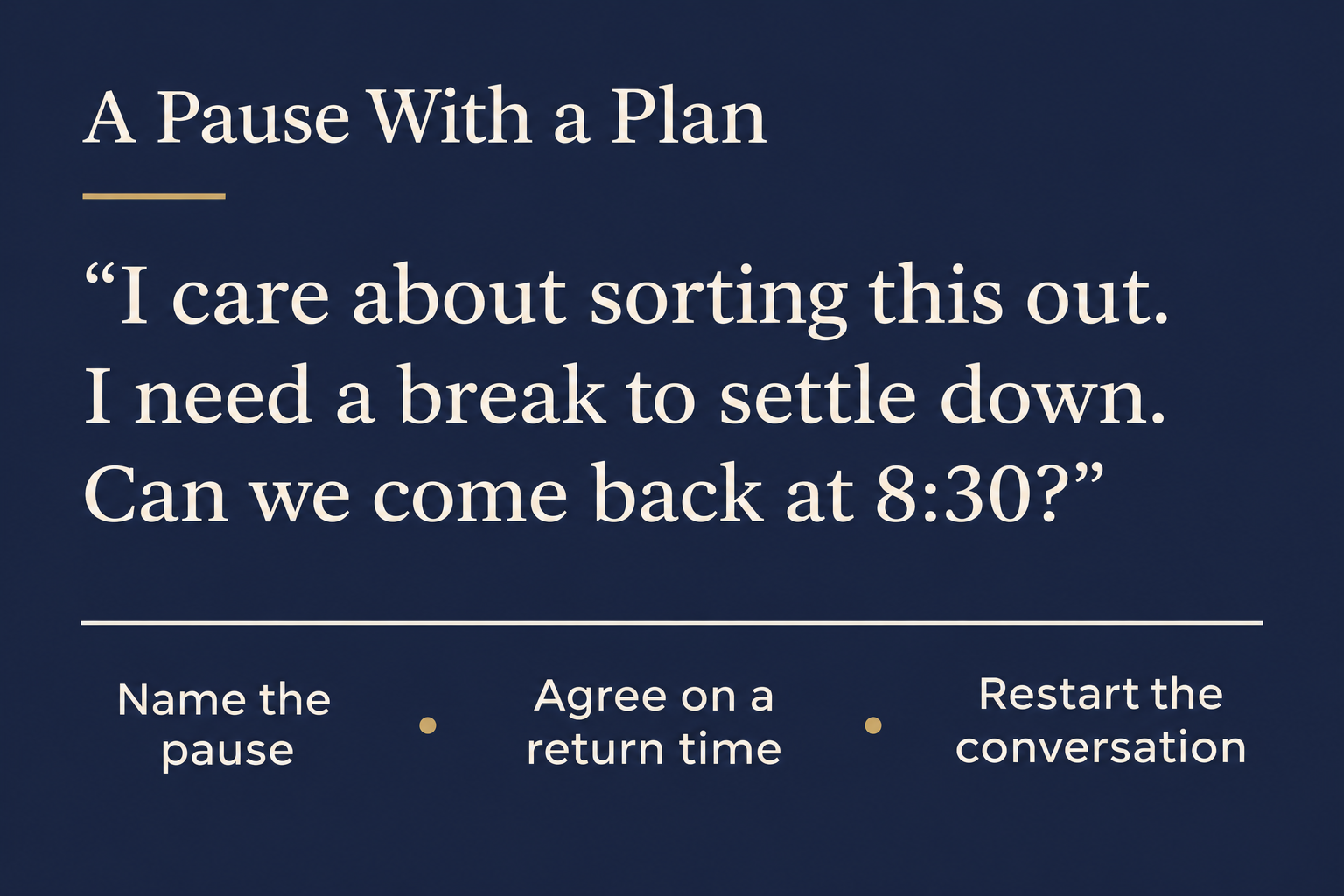
When you cannot discuss the issue calmly, take some time apart and agree on when you will check back in.
For example:
“I care about sorting this out. I'm too upset to have a useful conversation right now. Can we take a break and come back at 8:30?”
A specific return time helps keep the concern from getting lost in another unfinished conversation. If you are still too upset at that time, say so and agree on another realistic time, ideally the same day.
A few ground rules keep a break from becoming avoidance:
The person who asks for the break is responsible for the return. If you call the pause, you are the one who restarts the conversation.
A break is not the silent treatment. Say what you are doing and when you will be back, rather than leaving or going quiet.
Use the time to settle yourself. Walk, drink some water, or sit somewhere quiet. Continuing the fight by text or rehearsing your next accusation keeps you in the same conversation.
The research on pausing is encouraging but narrow. In a 2024 lab study of 81 couples, pauses as short as five seconds reduced negative emotion and aggressive responses during a competitive game. The participants were mostly young students who did not live together, and the researchers said the findings apply to everyday, lower-level conflict, not to abusive situations. The study does not establish how long a planned break during a real disagreement should last. Think of a planned break as a practical extension of the same idea: a little distance can make it easier to respond instead of react.
When you return, check whether you can each speak and listen with more care.
3. Restart with one specific concern
A disagreement about tonight's dishes can quickly become a discussion about every time someone has felt unsupported.
Those older experiences may matter. Trying to resolve them all at once can leave you with too much to understand and too little direction.
Choose the concern you want to address first.
Compare these openings:
“You always leave everything to me.”
“I've handled dinner and cleanup most nights this week, and I'm worn out. Can we work out a different arrangement?”
The second opening gives your spouse a situation to understand and a request to consider. It also leaves room for their experience.
Keep the request direct. Beginning with “I feel” does not soften a character judgment such as “I feel like you're selfish.”
A useful starting point is:
What happened, how it affected you, and what you are asking for now.
If another issue comes up, acknowledge it and agree on when to discuss it. Give the current concern enough attention to reach a useful next step.
4. Understand both the feeling and the practical problem
A recurring argument can carry more than the immediate issue.
Being late might leave one spouse feeling that their time does not matter. An unexpected purchase might bring up worry about financial stability. An unfinished chore might add to an already exhausting workload.
Ask what the situation meant to your spouse:
“What was the hardest part of that for you?”
Then check your understanding:
“You'd already reminded me twice, and having to ask again made you feel like you were carrying the planning too. Have I understood?”
The NHS recommends active listening, including repeating back what someone has said and asking for more detail when something is unclear, as a way to check you understand.
You can recognize an impact while remembering some details differently. Once you understand the concern, explain your perspective without dismissing theirs.
Give the practical issue attention, too. If the workload is uneven, a more caring conversation needs to lead to a workable division of responsibilities. If the budget keeps being exceeded, you need an agreement about spending.
Feeling heard and changing an unhelpful arrangement can both be necessary.
5. Give each person room to finish
When both people are trying to be understood at once, the discussion can become a competition for speaking time.
Try taking turns long enough for each person to explain one concern. The listener can ask questions and briefly summarize what they heard before sharing their own experience.
You might say:
“I want to hear your side fully. Then I'd like a chance to explain what was happening for me.”
Listening does not require you to accept every interpretation as fact. It gives you a better chance of responding to what your spouse actually means.
Be specific when you take responsibility:
“I said I would handle that, and I didn't. I understand why you're frustrated.”
You can discuss other parts of the disagreement separately. Let the acknowledgment stand long enough to be received.
6. Make one agreement you can both understand
An argument can end with “I'll try harder” and return a week later because neither person knows what that promise was supposed to change.
Make the next step visible.
If the concern is feeling disconnected after work, you could agree to spend ten minutes catching up before either person opens a laptop.
If the concern is the family's logistics, decide who owns a particular task from start to finish, including remembering, planning, and following up. For example, one spouse owns school forms, pickups, and teacher emails for the month.
If you keep arguing about money, agree on a spending decision you will discuss together before acting. For help approaching that topic, read How to Talk to Your Spouse About Money Without Fighting.
Before finishing, ask:
What exactly are we each agreeing to do?
Is this realistic for both of us?
When will we see how it is working?
If you cannot reach an agreement yet, identify what remains unresolved and when you will return to it. You can make progress without forcing a decision simply to end the discomfort.
7. Repair what happened during the argument
Resolving the original issue may leave something else needing attention: how you treated each other while discussing it.
You might agree on the household task and still need to apologize for a cutting remark.
A clear apology names your action and its impact:
“I interrupted you and made a sarcastic comment. That was disrespectful. I'm sorry. I want to hear what you were trying to say.”
Give your spouse time to respond. An apology opens the door to repair; they may need more conversation or time before they feel ready to reconnect.
Later, consider what you want to change the next time tension rises. Perhaps you will ask for a break earlier, bring up a concern sooner, or acknowledge a missed commitment without debating whether your spouse should be upset.
Why does the same argument keep coming back?
Usually because the concern was never fully understood, never turned into a clear agreement, or never followed through on. Look at what remains unfinished after the conversation ends.
Was the underlying concern understood? Did you agree on a change? Was that change realistic? Did anyone follow up?
Sometimes you understand each other well and still want different things. One spouse wants more time with extended family; the other needs more quiet time at home. That may require an arrangement you revisit as circumstances change.
Sometimes an agreement was never clear enough to carry out. In that case, go back to section 6 and make the next step specific.
Sometimes a promise was clear and was not kept. Raise it as a specific, recent example rather than a verdict on your spouse's character:
“We agreed you'd handle the school forms by Friday, and they're still not done. Can we talk about what got in the way and what would make this workable?”
Then listen to the answer. A missed commitment may point to an unrealistic plan, a busy season, or a pattern that needs a more direct conversation. Agree on a smaller step and a date to check in.
Returning to an issue can be productive when you bring new understanding or adjust a plan. If you keep having the same exchange with no change afterward, give the follow-through as much attention as the conversation itself.
Give concerns a regular place before they build up
Think about the last concern you postponed.
Maybe the timing never seemed right. Maybe you worried it would become an argument, so you stayed quiet until frustration made it harder to speak gently.
A regular conversation gives you a place to bring smaller concerns, recognize what is going well, and revisit decisions. The NHS also recommends checking in regularly so challenges can be managed as they arise instead of building up.
Happy & Married's Reflect & Connect Method™ provides a structure for that habit:
Reflect: Each spouse completes a private Weekly Marriage Check-In at happyandmarried.com, in about 10 minutes, to consider how the relationship has felt that week and what deserves attention. Doing this on your own first gives you time to name a concern calmly, before frustration decides when and how it comes up. The Check-In covers areas like Communication and Conflict & Repair, so the things you tend to argue about have a place to be noticed early.
Connect: You bring what you choose to share into a weekly Marriage Meeting together, offline. Individual Check-In responses stay private.
The meeting gives you an opportunity to appreciate each other, discuss a relevant concern, and revisit something you agreed to try. You can focus on the areas that matter most that week.
A weekly conversation still needs listening, accountability, and action. Its value is giving those efforts a regular place in your life.
To try it, start your free Marriage Check-In. For help structuring the conversation afterward, explore the Marriage Meeting Guide.
What if your spouse is not ready to try?
You can begin by changing your own contribution: raise concerns more specifically, acknowledge your actions, or ask for a pause before you speak harshly.
Then make a manageable invitation:
“I miss being able to talk without this happening. Would you be willing to set aside some time this weekend to discuss one thing, with a break if we need it?”
Your efforts can change how you participate. You cannot take responsibility for your spouse's behavior or make them engage.
If arguments keep repeating, conversations remain hurtful, or you struggle to make progress together, additional support may help. A qualified couples counselor can help you examine the pattern and practice different responses.
You can explore providers through Happy & Married's Relationship Resources Network, checking their qualifications, services, and availability for your needs.
If you do not feel safe
Disagreement is normal. Fear is not. If your spouse threatens you, controls what you do or who you see, damages your belongings, or hurts you, or if you change what you say because you are afraid of how they will react, this is a safety concern, not a communication problem. Taking turns, taking breaks, and taking responsibility for your own part will not make you safe.
The National Domestic Violence Hotline offers free, confidential support at 1-800-799-7233, or by chat at thehotline.org. If you are in immediate danger, call 911.
Common questions
Is it normal to argue with your spouse every day?
Most couples disagree regularly, and disagreement alone does not mean something is wrong. What matters more is how the disagreements go: whether you can speak honestly, stay respectful, and reach some next step. If daily arguments leave you dreading time together, feeling unheard, or feeling afraid, it is worth changing the pattern and getting support if you cannot do it alone.
How long should a break last?
There is no single right length. Take long enough to settle your body and thoughts, and set a specific time to return, ideally the same day. If you are both still too upset when you reconvene, agree on a new time rather than dropping the subject.
Should we see a counselor?
Consider it if the same arguments keep repeating, conversations regularly turn hurtful, or you cannot make progress on your own. Counseling is also a reasonable step before things feel dire. If safety is a concern, start with the resources above.
Begin with a conversation you can return to
When you are tired of arguing, even bringing up the problem can feel exhausting. You may wonder whether it will become one more fight.
Begin with a simple invitation, at a calm moment rather than in the middle of tension:
“I love you, and I want us to find a better way to talk about the things that matter.”
Then give that intention a practical shape: a time to talk, one concern to understand, and one change you can realistically try.
Over time, look for the moments that are becoming different. You listened longer. You caught yourself before saying something hurtful. You returned when you promised. You acted on what your spouse told you.
Those are changes worth noticing, and continuing.
The Happy & Married Team
We help couples build stronger marriages through one simple weekly habit — the Reflect & Connect Method™.