
How to Talk to Your Spouse About Money Without Fighting
You want to be able to talk about money with the person you’re building a life with.
You want to mention a bill without ruining the evening. Ask about a purchase without sounding like a parent. Admit that you’re worried without making your spouse feel they’ve let you down.
And you probably want something else, too: to feel that you’re carrying it together.
But money conversations can become tangled in everything you haven’t quite said. The pressure of being responsible for the bills. The disappointment of postponing something you were excited about. The feeling that your hard work goes unnoticed, or that every small enjoyment needs defending.
By the time someone says, “We need to talk about money,” there may already be weeks of frustration behind the words.
Learning how to talk to your spouse about money without fighting starts with making room for those feelings earlier. A regular opportunity to reflect, speak honestly, and listen can help you address a concern while it’s still something you can discuss with care.
That’s the purpose of Happy & Married’s Reflect & Connect Method: reflect individually through a Weekly Marriage Check-In, then connect through a Marriage Meeting. It gives you a place to notice what’s weighing on you and bring it into a conversation you both know is coming.
What you’re hoping your spouse will hear
Imagine that you’ve been watching your account balance all week. You’ve mentally accounted for groceries, the mortgage, and a repair you can’t put off. Then your spouse mentions plans for an expensive dinner.
To them, it may be a chance to spend time together. To you, it may feel like one more responsibility you’ll have to figure out.
You respond sharply. They feel rejected. Now you’re defending your reaction while they’re defending their intentions.
Neither of you has explained what mattered in that moment.
You may have needed to say, “I’m worried, and I don’t want to be the only one thinking about how we’ll cover everything.”
Your spouse may have needed to say, “I miss enjoying time with you. I was trying to give us something to look forward to.”
A purchase has a price, and it can also carry personal meaning. Understanding that meaning gives you more to work with when you sit down to make a decision.
The financial facts still matter. So does knowing what your spouse is asking you to understand.
Reflect: understand what’s bothering you before you bring it up
It’s difficult to explain a feeling you haven’t had a moment to understand yourself.
Sometimes “You’re spending too much” is the first thing that comes out because it’s easier to say than “I’m afraid we’re falling behind.” Sometimes frustration about a bill is also frustration about being the person who always remembers it.
The Reflect part of Happy & Married’s method creates space for that awareness.
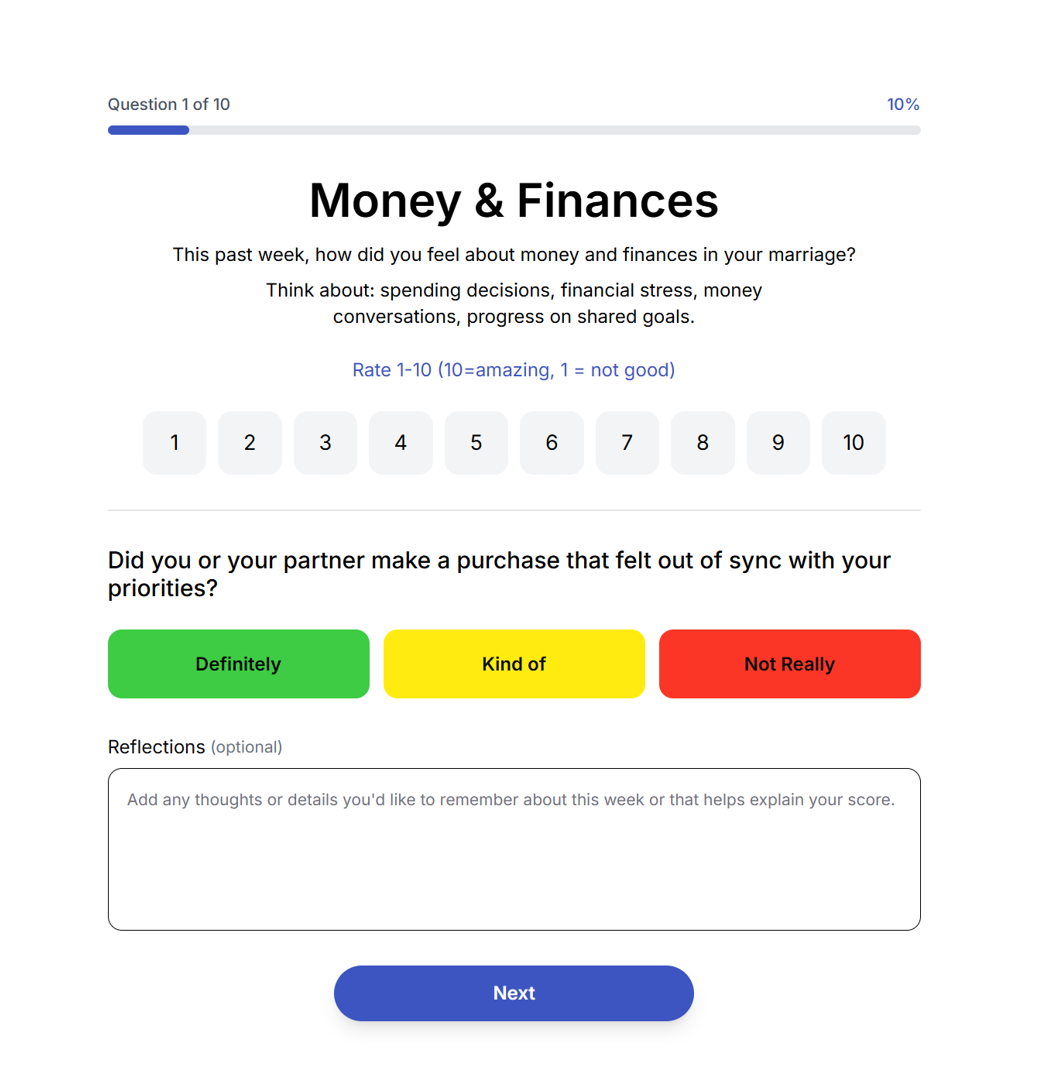
During your Weekly Marriage Check-In, you privately reflect on the areas shaping your marriage, including Money & Finances. This is an opportunity to consider how that part of your shared life has felt during the week.
Perhaps you feel comfortable with your financial direction but overwhelmed by managing the details. Perhaps you’ve made progress together and haven’t stopped to appreciate it. Or perhaps something has been bothering you, and you’re only now recognizing how much.
As you reflect, consider:
What felt reassuring or stressful about money this week?
Did I feel included and supported in our financial decisions?
What would I like my spouse to understand?
Your Check-In gives you a starting point. You choose what to bring into the conversation.
That preparation can change how you approach your spouse. You can arrive with a concern you understand and a request they can respond to.
Connect: give the conversation a place in your week
If money only comes up when something has gone wrong, the subject can start to feel like a warning.
A regular Marriage Meeting creates another way to begin. You both know there will be time to talk about what’s working, what needs attention, and what’s coming next.
Money can have a place in that conversation before an unexpected charge or missed payment forces the issue.
You might say:
“When I did my Check-In, I realized I’ve been more worried about our finances than I’ve let on. Could we spend some time on that tonight?”
Or:
“I felt good about how we handled the car repair together. I’d love for us to approach the upcoming holiday expenses the same way.”
There’s room for appreciation as well as concern. You’re building a habit of paying attention to this part of your marriage together.
A Marriage Meeting also doesn’t have to become a full budgeting session. You may identify an issue, talk about how it’s affecting you, and arrange a separate time to work through the numbers. Give a complicated financial decision the time it needs.
And if something is urgent, bring it up promptly. A regular meeting gives you dependable time together; it shouldn’t delay a conversation that needs to happen sooner.
Begin with what you feel and what you need
Even with time set aside, the first few sentences deserve care.
“You never think about our future” is likely to lead to an argument about whether that accusation is fair. Your actual concern may get lost.
Try being more specific:
“I’ve been anxious about how little we have left after bills. I’d like us to look at what we can realistically save.”
Or:
“Keeping track of all the payments has been wearing me out. I need us to share more of that responsibility.”
You don’t have to make your concern smaller to say it kindly. Be honest about the impact and clear about what you’re asking for.
If a financial agreement has been broken, name that too:
“We agreed to discuss purchases above that amount. Finding out afterward was upsetting, and we need to talk about what happened.”
Respectful language leaves room for accountability. It helps you stay focused on the decision or behavior you need to address.
Make room for an answer you didn’t expect
Once you’ve explained yourself, give your spouse time to respond.
They may have understood the situation differently. They may have information you don’t have. They may also have a concern they’ve struggled to bring up.
Ask:
“How has this been feeling for you?”
Listen long enough to understand their answer before offering a solution. Then check what you heard: “You feel like we keep cutting out the things you enjoy, and you want more say in what we prioritize. Is that right?”
You can understand that feeling and still disagree about an expense.
This is where connecting becomes useful in a practical way. Once you know what each of you needs, you can consider options that address more of the concern.
Maybe you need a less expensive way to spend time together. Maybe you need clearer limits you both helped choose. Maybe you need to redistribute the work of managing the household finances.
You won’t know until both of you have had a voice.

Look at the numbers together, then choose a next step
Feelings deserve attention, and a financial decision needs accurate information.
Bring the relevant bill, balance, due date, or estimate into the conversation. Make sure you’re looking at the same picture before deciding what to do.
One spouse may be more comfortable with finances or handle most of the administration. Both still deserve to understand decisions affecting your shared life. Earning more money should not give one person the deciding vote, and unpaid caregiving should not diminish anyone’s voice.
Then make your next step specific enough to follow.
“We need to spend less” may leave you with different expectations. A clearer agreement might be:
“Let’s review our subscriptions by Thursday, choose which ones to keep, and put the changes into next month’s budget.”
If the problem is that necessary expenses exceed your income, acknowledge that reality. Kindness matters, but it won’t close a financial shortfall. You may need qualified help working through the available options.
You don’t have to solve everything in one conversation. Aim to leave knowing what happens next and who will take responsibility for it.
When emotions rise, protect the opportunity to keep talking
You can prepare thoughtfully and still find yourselves getting upset.
If you’re raising your voice, repeating accusations, or struggling to listen, acknowledge it before continuing:
“This matters to me, and I want us to work through it. I’m too upset to listen well right now. Can we take a break and come back after dinner?”
Choose a return time together. Use the break to settle yourself, and come back willing to hear your spouse.
If you said something hurtful, repair that directly: “Calling you selfish was unfair. I’m sorry. I want to explain why I’m worried without attacking you.”
An apology can reopen the conversation. You still need to address the concern that brought you there.
Regular Check-Ins and Marriage Meetings won’t eliminate disagreements. They give you repeated opportunities to practice speaking honestly, noticing tension, and returning to issues that need care. Both spouses have to participate for that habit to become useful.
Notice progress you might otherwise miss
It’s easy to measure financial progress only by an account balance.
There are other changes worth noticing in your marriage, too. You brought up a concern sooner. Your spouse listened without interrupting. You made a decision together that one person used to carry alone.
Make room to acknowledge those moments.
Over time, Happy & Married Premium’s Data-Driven Marriage experience brings weekly reflections into a shared view, with a Marriage Score, trends, and alignment across marriage areas while individual responses stay private.
That perspective can give you something to explore together: Has Money & Finances continued to feel difficult? Are your experiences different? How has this area felt across recent weeks?
The scores don’t decide who is right or which purchase you can afford. They provide another starting point for a conversation about your relationship—one you can approach with curiosity and care.
When you could use a little extra support
Sometimes a conversation helps you recognize where you could use more guidance. You may want help creating a financial plan, working through recurring disagreements, or finding an approach that feels manageable for both of you.
Happy & Married’s Relationship Resources Network is a place to explore providers and resources for additional support. Consider together what kind of help would be useful and which provider fits your needs.
Recognizing when you could use help is another way to give your marriage intentional attention.
Bring It Into Your Marriage
This week, begin with your own Marriage Check-In. Give yourself time to notice how Money & Finances has felt, including anything you appreciate and anything you’ve been holding back.
Then bring one observation into your Marriage Meeting:
“Something I realized during my Check-In is…”
Let that be the beginning. Give your spouse room to share their perspective, and choose one thing you can address together.
Being able to say “I’m worried” and hear “Let’s look at it together” is a meaningful part of building a life with someone. A regular place for those conversations gives you a chance to offer that support before either of you reaches a breaking point.
The Happy & Married Team
We help couples build stronger marriages through one simple weekly habit — the Reflect & Connect Method™.